

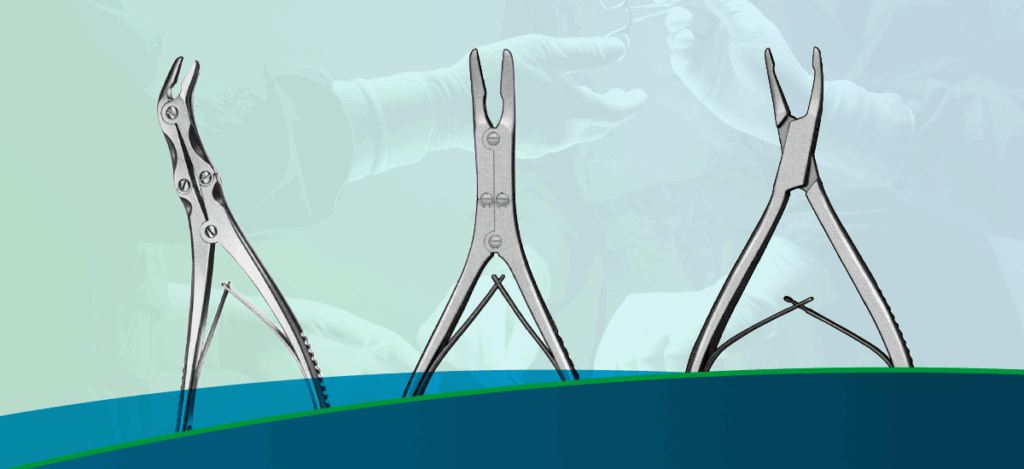
Few surgical instruments demand the precision and durability of a surgical rongeur. The right rongeur becomes an extension of the surgeon’s hands, yet with dozens of patterns, varying material grades and inconsistent quality control, selecting the optimal instrument poses challenges.
This guide provides a framework for informed choices, covering design fundamentals, testing methods and quality markers that separate exceptional rongeurs from those that fail.
Understanding the blueprint of rongeur design is essential. The instrument’s jaw configuration, action mechanism and handle ergonomics directly dictate its performance in specific surgical contexts.
Surgical specialty dictates rongeur requirements. Orthopedic procedures, like joint replacements and trauma repairs, require robust instruments with substantial bite force, which is why the Leksell bone rongeur excels with its double-action mechanism. Neurosurgery demands precision over power, and when navigating the spinal canal or removing thin bone near the dura, patterns like the Kerrison deliver controlled removal with minimal risk.
Three features define performance: jaw type, action mechanism and handle design. Cup-shaped jaws scoop bone while angled jaws access confined spaces. Single-action provides direct control — double-action amplifies force for aggressive removal. Finger loops ensure grip, and spring-loaded handles reduce fatigue during extended procedures.
The decision often comes down to choosing between power and finesse.
The Leksell bone rongeur serves as the workhorse for aggressive bone removal. Its double-action cam-and-lever system multiplies applied force, enabling rapid removal of larger segments with reduced hand fatigue. Robust construction and a wide jaw opening make it ideal for laminectomies where speed and power take priority.
The Friedman bone rongeur — often called the Luer-Friedman rongeur — employs a single-action design for direct force transmission, delivering exceptional tactile feedback and fine control. Neurosurgeons favor this pattern near critical structures, where predictable action reduces the risk of tissue damage while offering unmatched precision.
The Kleinert-Kutz rongeur features fine jaws and compact dimensions for hand and microsurgery. The Ferris-Smith-Kerrison rongeur combines the Kerrison footplate design with modified jaw geometry for spinal laminectomies that require controlled depth penetration.
The following steps provide a practical framework for verifying instrument quality.
gSource distinguishes itself through verifiable design, materials and performance.
Every rongeur we sell is precision-manufactured from German or U.S. surgical steel that offers superior edge retention, corrosion resistance and durability through repeated sterilizations. Our Lifetime Workmanship Guarantee backs every instrument. If your rongeur fails due to a manufacturing defect, we replace it.
These rongeurs pass comprehensive testing, including a visual inspection for defects, the Index Card Test for sharpness and alignment and mechanical action verification. Our ISO 13485 certification and FDA registration provide third-party validation of our quality management systems.
Browse the complete selection of Friedman and Leksell rongeurs manufactured to relevant standards. Whether you need double-action Leksell power or single-action Friedman finesse, gSource delivers the quality your procedures demand.
These answers address common considerations when selecting rongeurs.
Rinse the rongeur under running water immediately after use, then use a soft brush to clean the jaw mechanism and hinge. Follow your facility’s standard sterilization protocol, which may include enzymatic cleaning, ultrasonic processing and autoclave sterilization. German surgical steel maintains sharp edges through hundreds of cycles.
Single-action provides direct force for exceptional tactile feedback and precision, ideal for delicate work near critical structures. Double-action multiplies force for aggressive removal with less fatigue. Choose finesse (single-action) for controlled contouring or power (double-action) for rapid removal.
While repairs are technically possible, they rarely restore original performance. High-quality instruments made from German surgical steel, rigorously tested and backed by lifetime guarantees, eliminate this concern — instruments perform reliably and can be replaced under warranty.
A surgical rongeur is far more than a purchase order line item — it’s an investment in surgical precision and patient safety. The difference between exceptional and mediocre instruments reveals itself through tactile feedback that prevents tissue damage, edge retention that maintains performance across hundreds of procedures and mechanical reliability. By applying rigorous testing and selecting manufacturers committed to verifiable quality, we ensure instruments meet patient safety standards.
Have questions about which rongeur pattern is right for your specialty? Our experts provide personalized guidance based on your procedural needs.
Contact us for more information or browse our catalog to purchase today.